What
In autumn 2025, the idea was that there was still room to enter the compute markets early. OUDAU could capture a first-mover advantage and become a neutral allocation layer where brokers create liquidity.
I have always been interested in markets. When I looked at AI, I was drawn to ideas that combined the game theory of markets with what was happening in AI. I wanted to build something grounded in the real economy and capture value somewhere along the path from the infrastructure being built to the models that we, as end users, use. I subscribe to the idea that the model is the product, so I began asking what kinds of companies would exist in that world and how I could position my own company for it.
Research and post-training need compute. If you were not going to be a model lab or do post-training yourself, one directional bet was to support that world through its need for more compute. Many different companies would be training models and building products, and beneath all of them is the journey from electricity all the way to the token.
Finding any useful position in that journey could be lucrative because, once you are part of that flow, you can add services or other products around it. CoreWeave acquiring OpenPipe is a much larger version of that playbook: start with compute, then add more of what customers want around it. Allocation was one way into that layer, and the broader bet was on being somewhere in the compute stack while it was still being built.
In my opinion, if you could be an early adopter, move into the compute vertical, and get somewhere on the route from data centers to labs, you should try. Back then, I saw an opportunity in Europe, which was behind and still is now. Even if Europe did not train its own models at all, inference and agents would still need compute served here. If you could enter that layer as a broker or in some other way, there was money to be made. I remember Mistral starting its compute offering back then, and I think today we can see how big that bet is going to become. Maybe even their only bet ;)
So I ended up with this, OUDAU. It took inspiration from my master's thesis, especially how traders and a market exchange bring liquidity to a market, which is needed to make it useful and help it function better, as adoption is hard to bootstrap in a new market.

As a larger idea, the compute marketplace / exchange was something that would be iterated on and built over time. The thinking was that you also needed tools or offerings that gave more immediate value and could slowly onboard users onto the platform, making it easier to transition into a full marketplace / exchange at some point.
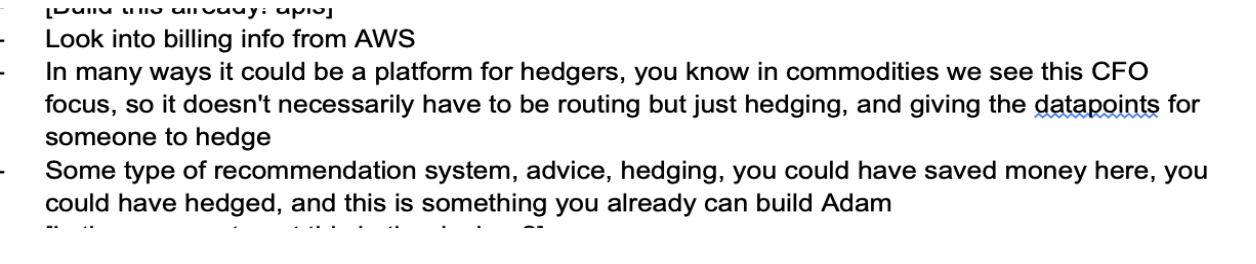
Cost visibility was one example. You could have tools that brought AWS billing, GPU spending, token billing, and other data points into a dashboard, giving you a broader idea of where your expenditure went. At the time, much of the FinOps work at companies focused on AWS billing. I thought those FinOps teams would also begin managing more of the spending on LLMs over time. That was part of the longer-term vision.
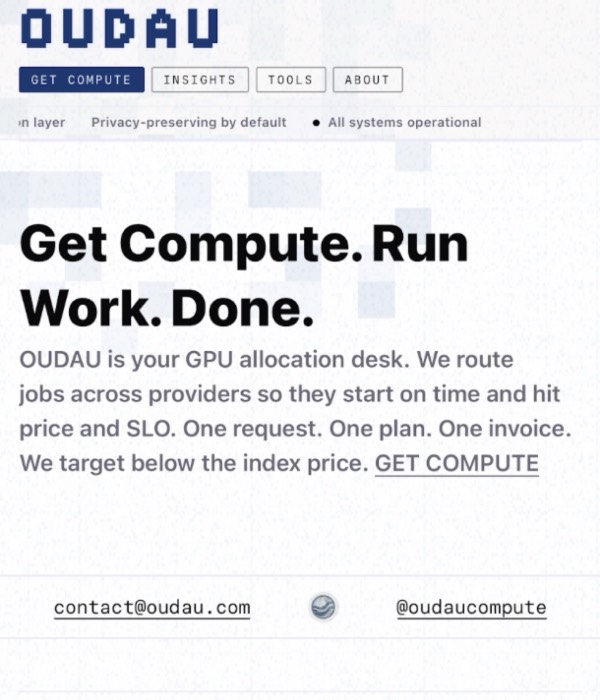
 UDAU was an attempt at building an allocation layer for AI, with compute as the starting point. The idea was to sit between GPU providers and the practitioners who needed capacity, find the best available option, arrange the deal, and send one invoice. A brokerage layer where allocators sourced, priced, and booked GPU capacity on behalf of clients.
The wider idea was allocation, not only routing. Sometimes allocation meant brokering and networking: knowing who had capacity, who needed it, and bringing them together. Other times it meant a technical orchestration system, more like routing, that could compare providers and allocate workloads automatically. I thought OUDAU would probably need both. At the same time, you could argue that this spread the idea too widely and that, as a startup, you should probably hone in on one thing.
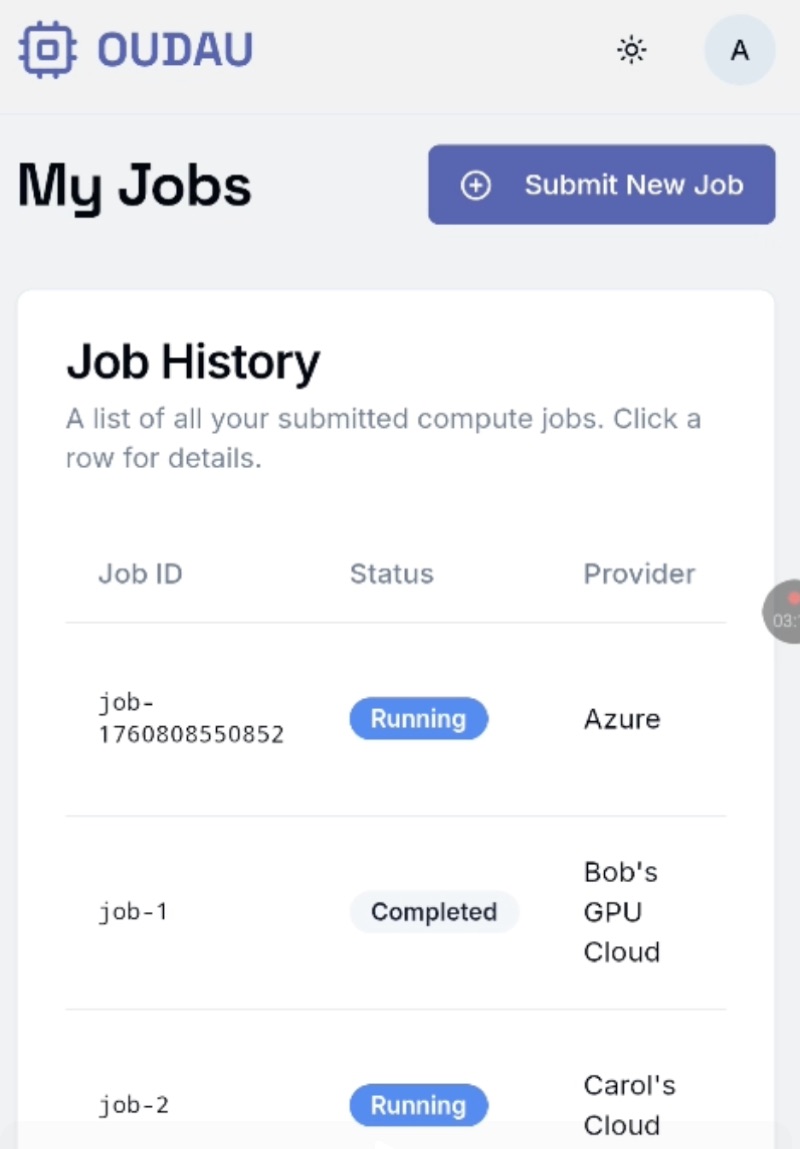
One of the first MVPs we landed on was exactly such a routing system: an orchestration tool for deploying and training across multiple clouds at the best available price. In some ways, it was a hosted dstack solution. The pitch was that ML teams should focus on building AI and doing research, not infrastructure plumbing. I still think this is interesting. The broader bet was simply to find a useful point of entry into the compute market and build from there.
If two companies sell roughly the same AI product, a big part of the competition between them will come down to how well they buy, hedge, and allocate their compute.
The dream was an allocation layer where traders or brokers came in and handled the brokering of larger contracts and people's compute needs. OUDAU would not do all the brokering itself. It would make the software that brokers used, and they would bring in customers to do the deals. OUDAU was not meant to become a middleman, but something more like an exchange where traders and brokers created liquidity. A true neutral layer.
As brokers and traders built credibility, more customers could choose to work with them through the platform, making the platform itself more useful. We wanted the brokering to happen on OUDAU, but if we were unable to bootstrap a network straight away, OUDAU would handle it in the beginning. Over time, the software could open that work to other brokers and traders. I had imagined the players as people, but they could also have been agents with their own strategies, procuring and routing compute on behalf of buyers and sellers.
One of the people who helped me most with OUDAU asked why someone would not simply bypass a middleman like us. Say you find compute through a broker. Why use OUDAU or that broker the next time once you already know the provider? That was an interesting and important question. I guess the same question applies to other exchanges like the one I wanted to build, and to how brokering works in markets such as shipping. It was a question I needed to go further into.
You could argue that fragmentation and the expertise needed give people a reason to keep using a broker. They may also simply want to spend time on what they actually want to do, rather than on solving the compute problem. If your expenditure on compute is high, OUDAU could handle that optimization problem by creating competition between brokers in an exchange-like environment.
In the end, OUDAU never came together as a startup. But since then, I have continued thinking about compute and done a lot of work around it. That thinking continues here and in The Compute Bazaar. And we may never know. OUDAU might come back. Compute is here to stay for many, many years, and the market will take longer to develop than people believe. I still think there are big possibilities for anyone willing to enter, across many verticals and in compute itself.
The Thesis
The framing of the allocation desk came from Dan Shipper's allocation economy: if models can increasingly do knowledge work, the scarce skill shifts from doing the work to directing it. The advantage becomes how well you allocate resources, not what you know.
At the most abstract level, OUDAU was meant to enable that allocation economy. It would be an exchange where allocators could route compute across providers and decide what should run where, when, and under what constraints.
I guess the idea was that brokering could take on much of the burden in an exchange environment. An exchange, marketplace, or futures market needs allocators and traders who actually trade it, including desks that may not already be connected to the underlying asset. But they need a reason to participate and a way to make money. That could come from spreads, hedging, insurance-like protection, or simply doing a better allocation job. You can build the marketplace, but you still need participants, liquidity, and movement for it to become a market.
Commodities teach one lesson: the financial layer ends up bigger than the physical market. Compute is entering that wave, where liquidity, futures, and hedging matter as much as training AI models. OUDAU is the neutral allocation layer built for this wave.

Compute is often compared to oil, but it's not a storable stock. It's temporal, priced in GPU-hours, consumed over time. Unused capacity is gone. It looks more like electricity than oil, one might say.
One estimate puts AI infrastructure spending at more than $7 trillion over the next 10 years, with Compute as a Service growing from around $30 billion in 2025 to more than $250 billion by 2034.
A comparable projection argues that hyperscalers, cloud providers, and Compute as a Service platforms that make the best use of capacity, capital, and energy will gain an edge during the estimated $6.7 trillion buildout.
As with the oil industry a century ago, compute is becoming a tradable commodity. Analysts expect a massive opportunity for new exchanges, hedging products, and specialist trading desks to emerge and capture that edge.
And this is exactly where things are moving: exchanges and brokers are arriving.
These early movers already prove that transparent pricing and smart routing between builders and providers create immediate value.
These numbers were useful for showing that there was a large market here. But, as far as I know, they were not what first made me interested in compute and making a marketplace.
Looking back, some of that interest may date back to George Hotz and his ideas around the decentralization of compute. But in general, just the George Hotz ethos, his main point was that you should not have to rent a machine; you should be able to submit a job and let the system find the compute. That system in my mind could be OUDAU. The stream I watched was George Hotz | Just Chatting | how to actually win? | tinygrad.org.
I think my interest in DRW and Cumberland's work on Canton is what eventually led me to Simeon Bochev's Trade GPU compute like you trade oil. Canton interested me because it was built for private financial workflows and could settle the asset and payment sides of a trade together, something I had researched extensively in my master's thesis. I mapped that idea onto compute. One version of the OUDAU argument was that the exchange could be built on Canton, with compute as the thing traded on it. Canton could be the exchange infrastructure, and compute could be what was traded on it.
In my mind, I thought that was how Compute Exchange was working. After a while, my sense was that they were not using Canton for the exchange itself, perhaps only in the long, long future. But that was how I connected the dots myself. The talk made the idea of compute as a market and tradable commodity very exciting. I also remember watching “AI is killing innovation. That has to change”, also by Simeon Bochev, CEO of Compute Exchange. It was cool and motivating.